Wednesday, April 18, 2012

microsatellites for sparids

Congratulation to Kerry for her first publication!
The paper is online in the early view section of Molecular Ecology Resources.
I am sure the paper will be useful for lots of people and highly cited !

High-throughput microsatellite marker development in two sparid species and verification of their transferability in the family Sparidae
K Reid, TB Hoareau and P Bloomer

Abstract:
Recently, 454 sequencing has emerged as a popular method for isolating microsatellites owing to cost-effectiveness and time saving. In this study, repeat-enriched libraries from two southern African endemic sparids (Pachymetopon blochii and Lithognathus lithognathus) were 454 GS-FLX sequenced. From these, 7370 sequences containing repeats (SCRs) were identified. A brief survey of 23 studies showed a significant difference between the number of SCRs when enrichment was performed
first before 454 sequencing. We designed primers for 302 unique fragments containing more than five repeat units
and suitable flanking regions. A fraction (<11%) of these loci were characterized with 18 polymorphic microsatellite loci (nine in each of the focal species) being described. Sanger sequencing of alleles confirmed that size variation was because of differences in the number of tandemrepeats. However, a case of homoplasy and sequencing errors in the 454 sequencing were identified. These newly developed and four previously isolated loci were successfully used to identify polymorphic markers in nine other economically important species, representative of sparid diversity. The combination of newly developed markers with data from previous sparid cross-species studies showed a significant negative correlation between genetic divergence to focal species and microsatellite transferability. The high level of transferability we described (48% amplification success and 32% polymorphism) suggests that the 302 microsatellite loci identified represent an excellent resource for future studies on sparids. Microsatellite marker development should commonly include tests of transferability to reduce costs and increase feasibility of population genetics studies in nonmodel organisms.

Journal Club Sessions (Semester 1)

Date
Name
Venue
12 Mar
Kerry
Tea room
19 Mar
Sarita
Tea room
26 Mar
Sam
Tea room
2 Apr
Arrie
Tea room
16 Apr
Thierry
Tea room
23 Apr
Emilie
Tea room
7 May
Ilkser
Tea room
14 May
Catherine
Tea room
21 May
Amanda
Tea room
28 May
Paulette
Tea room
4 June
Bianca
Tea room
11 June
Michael
Tea room
18 June
Angelika
Tea room
25 June
Carel
Tea room

Monday, March 19, 2012

The historical Biogeography of Mammalia

Today, Sarita will present a paper on historical biogeography of mammals. The authors proposed to identify the origins of the different groups of mammals by comparing nine different methods for reconstructing ancestral areas including data on phylogenies, divergence times and ancestral areas reconstructions. This approach shows that both dispersal and vicariance triggered diversification of mammals. Thanks Sarita.

From MS Springer, RW Meredith, JE Janecka and WJ Murphy, Philosophical Transactions of the Royale Society B, (2011) 366, 2478–2502 [doi:10.1098/rstb.2011.0023]


Title: The historical biogeography of Mammalia

Abstract. Palaeobiogeographic reconstructions are underpinned by phylogenies, divergence times and ancestral area reconstructions, which together yield ancestral area chronograms that provide a basis for proposing and testing hypotheses of dispersal and vicariance. Methods for area coding include multi-state coding with a single character, binary coding with multiple characters and string coding. Ancestral reconstruction methods are divided into parsimony versus Bayesian/likelihood approaches. We compared nine methods for reconstructing ancestral areas for placental mammals. Ambiguous reconstructions were a problem for all methods. Important differences resulted from coding areas based on the geographical ranges of extant species versus the geographical provenance of the oldest fossil for each lineage. Africa and South America were reconstructed as the ancestral areas for Afrotheria and Xenarthra, respectively. Most methods reconstructed Eurasia as the ancestral area for Boreoeutheria, Euarchontoglires and Laurasiatheria. The coincidence of molecular dates for the separation of Afrotheria and Xenarthra at approximately 100 Ma with the plate tectonic sundering of Africa and South America hints at the importance of vicariance in the early history of Placentalia. Dispersal has also been important including the origins of Madagascar’s endemic mammal fauna. Further studies will benefit from increased taxon sampling and the application of new ancestral area reconstruction methods.

Monday, January 16, 2012

Journal Club Sessions (Semester 1)

Date

Name

Venue

16 Jan

Arrie

7-34

23 Jan

Thierry

7-34

30 Jan

Emilie

7-34

6 Feb

Ilkser

7-34

13 Feb

Catherine

7-34

20 Feb

Amanda

Tea room / Office

27 Feb

Paulette

Tea room / Office

5 Mar

Carel

Tea room / Office

12 Mar

Kerry

Tea room / Office

19 Mar

Sarita

7-34

26 Mar

Sam

7-34

2 Apr

Arrie

7-34

16 Apr

Thierry

7-34

23 Apr

Emilie

7-34

7 May

Ilkser

7-34

14 May

Catherine

7-34

21 May

Angelika

7-34

28 May

Paulette

7-34

Tuesday, November 29, 2011

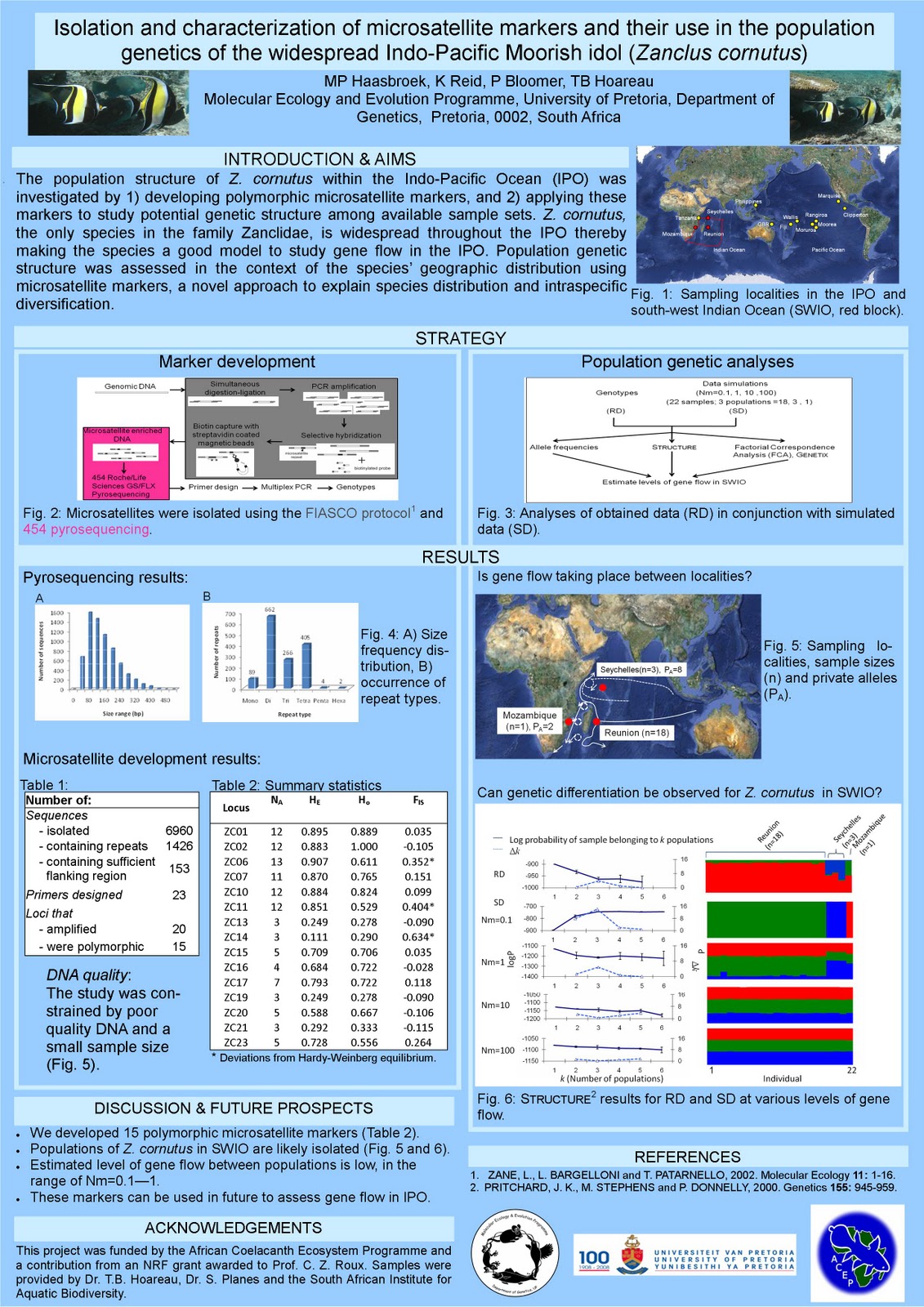
Microsatellite development in the Moorish Idol

Congratulation to Miekie for her nice poster on development of microsatellites in the Moorish Idol (Zanclus cornutus)! Good job!

Thursday, October 27, 2011

Design of hybrid primers

Failures in PCR amplification is very common in a molecular lab as multiple factors can affect it (DNA quality,  parameter of the PCR program, use of non-specific primers etc.). So, we have to limit these issues as much as we can. One way is to design good primers. The problem is that often it is not possible to have 25bp of conserved region of interest for the studied taxon. A previous paper that focused on protein evolution got around this issue by showing that 3 to 4 conserved codons were enough to design a good primer (Rose et al. 1998). More recently, adapting this approach to nucleotide sequences, we developed a set of conserved (and efficient) COI primers for the echinoderm phylum (sea-urchins, sea-cucumbers, sea-lilies or crinoids, sea-stars and brittle-stars; Hoareau & Boissin 2010). I used the same approach to design the ND2 primers for the whole vertebrates. I think this is very worthy as the same set of primers can be used by everyone in the lab. See below the graph that shows a conserved 3' region for each primer.
Sometimes, it will not work if we cannot find a conserved region long enough to design the primers. But I suggest that if you have to design primers (other than microsatellites!) you should try this method. Soon enough, we will have only a small set of primers for all the species in the lab.


Alignment of ND2 sequences (+ flanking regions) of various vertebrates showing the regions where I designed the primers

Friday, September 2, 2011

Vicariance and adaptation in a common temperate ophiuroids


Congratulations to Emilie (and her colleagues) for their new paper in Molecular Ecology. It has just been accepted. Find below the details of this nice paper.


Title: Did vicariance and adaptation drive cryptic speciation and evolution of brooding in Ophioderma longicauda (Echinodermata: Ophiuroidea), a common atlanto-mediterranean ophiuroid?


Authors: Emilie Boissin, Sabine Stohr and Anne Chenuil


Abstract: Over the last decade, cryptic speciation has been discovered in an increasing number of taxa. Species complexes are useful models for the understanding of speciation processes. Motivated by the discovery of brooding specimens in the common Atlanto-Mediterranean broadcast spawning brittle star, Ophioderma longicauda, a recent study revealed the occurrence of divergent mitochondrial lineages. We analysed 218 specimens from 23 locations spread over the geographic range of the species with partial Cytochrome c Oxidase subunit I (COI) sequences. A subset of this sample was also surveyed with the internal transcribed spacer of the ribosomal DNA cluster (nuclear ITS-1). Our study revealed six highly divergent mitochondrial lineages and the ITS-1 data confirmed that they most likely represent a species complex. Geographic ranges, abundances and genetic structures are contrasted among the putative cryptic species. Lineages in which brooding specimens have been found form a monophyletic group and are restricted to the Eastern Mediterranean basin, an oligotrophic zone. A phylogeny-trait association analysis revealed a phylogenetic signal for low  ‘chlorophyll a’ values (our proxy for oligotrophy). An ecological shift related to the hyper oligotrophy of the Eastern Mediterranean region is therefore likely to have played a role in the evolution of brooding. This study revealed that a complex mixture of vicariance, population expansion, adaptive divergence and possibly high local diversification rates resulting from brooding has shaped the evolution of this species complex. The dating analysis showed that these events probably occurred in the Pleistocene epoch.
Brooded juvenile (SEM image) and adult (picture) of Ophioderma longicauda